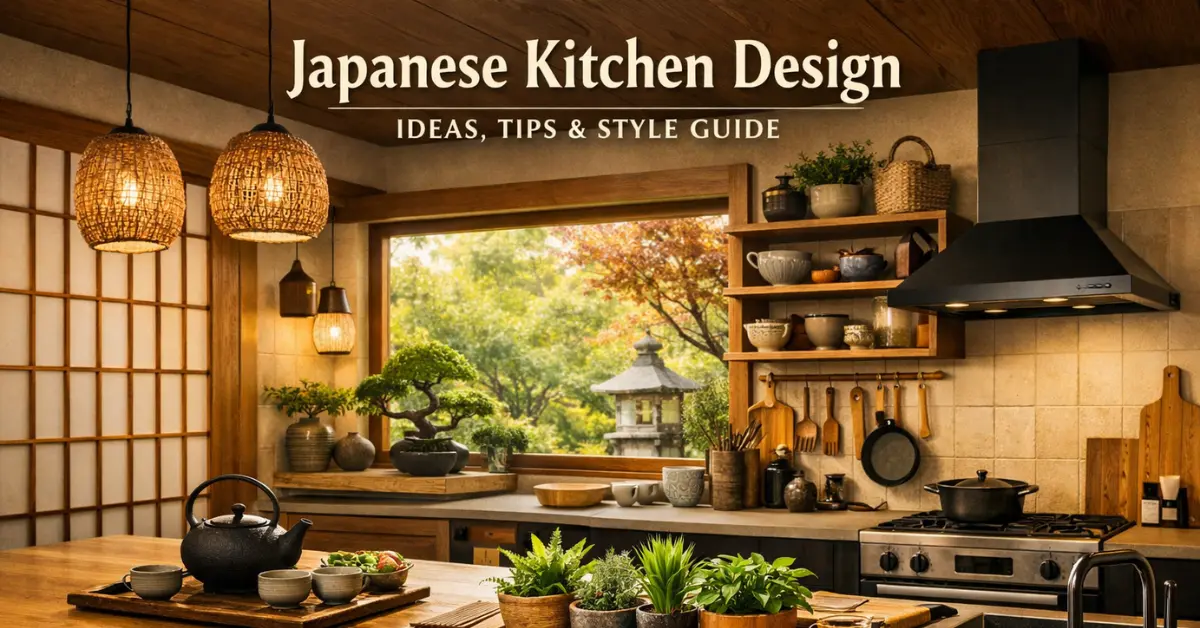
Walk into a Japanese kitchen and you feel it immediately — a quiet calm, a sense of order, and a warmth that no amount of trendy decor can fake. Japanese kitchen design is not just an aesthetic. It is a way of living. It tells you that your home should feel like a refuge, not a showroom.
Whether you are renovating your entire kitchen or just refreshing the look, this guide gives you everything you need to design a Japanese kitchen that is beautiful, practical, and truly yours.
What Is Japanese Kitchen Design?
A Japanese kitchen is built on three core ideas: simplicity, harmony with nature, and purposeful function. Every cabinet, countertop, and shelf earns its place. Nothing is there just for show, yet everything feels warm and intentional.
This style has deep roots in Japanese culture and philosophy. Since the early 17th century, Japanese interior design has inspired the Western world with its refined lines and quiet beauty. Today, modern Japanese kitchens honor those traditions while embracing contemporary materials and technology.
The result is a space that feels calm without being cold, minimal without being empty, and elegant without being untouchable.
The Key Philosophies Behind a Japanese Kitchen
Most competitor articles talk about “minimalism and natural materials” — but they skip the actual philosophies that make a Japanese kitchen feel the way it does. Understanding these ideas helps you make better design decisions.
Ma — The Power of Intentional Space
Ma (間) is a Japanese concept that means “negative space” or “pause.” In a Japanese kitchen, Ma is not about leaving things empty by accident. It is about choosing space on purpose. A clear countertop, a single bowl on a shelf, an uncluttered corner — these moments of quiet give the room its calm energy.
Designing with Ma means resisting the urge to fill every surface. Leave breathing room. Let your best pieces stand out.
Wabi-Sabi — Beauty in Imperfection
Wabi-Sabi (侘寂) is the philosophy of finding beauty in imperfection, age, and the natural passage of time. A stone countertop that develops a soft patina, a hand-thrown ceramic mug with uneven edges, a wooden shelf that shows its grain — these are not flaws. They are the soul of the space.
In a Japanese kitchen, you do not chase perfection. You appreciate what is real, honest, and alive. This mindset is especially freeing when you are designing on a budget. An aged cutting board or a second-hand ceramic pot can be more beautiful than a brand-new decorative item.
Kanso — Elimination of Clutter
Kanso (簡素) means simplicity through the removal of the non-essential. It asks: does this item serve a purpose? If not, it does not belong in the kitchen. This principle helps you curate every object with intention, so the room feels clean and peaceful rather than bare or cold.
Core Elements of a Japanese Kitchen
1. A Neutral, Nature-Inspired Color Palette
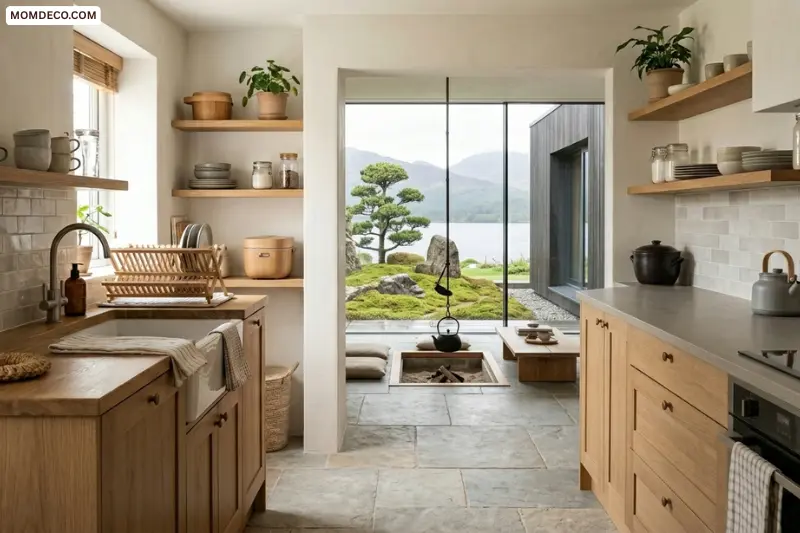
The Japanese kitchen color palette is quiet and grounded. Think:
- Warm whites and off-whites — they brighten the space without making it feel clinical
- Soft greys and stone tones — grounded and sophisticated
- Earthy browns and warm beiges — brought in through wood and natural materials
- Muted greens — a nod to nature, used sparingly on cabinets or in plants
Avoid bright colors, bold patterns, or high-gloss finishes. The goal is a palette that recedes into the background so the materials themselves become the visual story.
2. Natural Materials That Age Beautifully
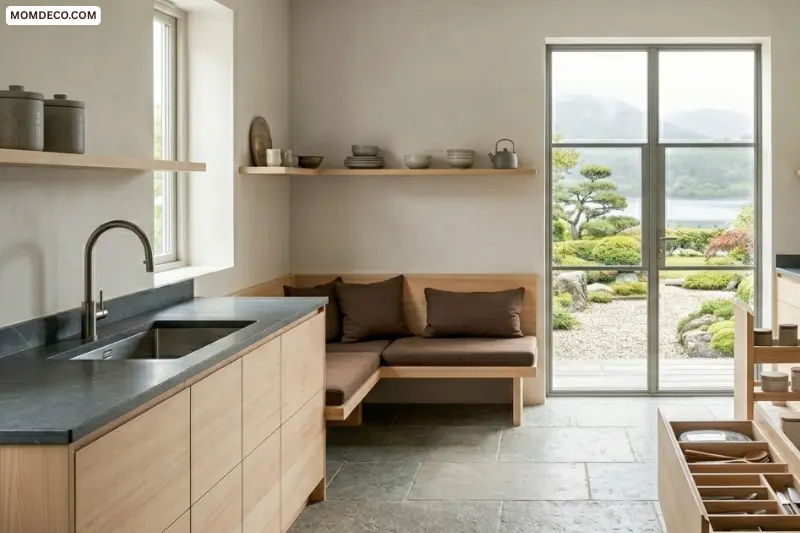
Natural materials are the heart of Japanese kitchen design. They bring warmth, texture, and a connection to the outdoors that no painted surface can replicate.
- Wood is the most important material. Light oak, hinoki cypress, and American walnut are all popular choices. Use wood for cabinet doors, open shelving, and countertops. Choose a matte or oiled finish over lacquer so the grain shows through.
- Stone works beautifully for countertops and backsplashes. Granite, soapstone, and honed marble all suit the aesthetic. Let them develop their natural wear over time — this is Wabi-Sabi in practice.
- Bamboo adds authenticity and sustainability. Use it for cutting boards, drawer organizers, or open shelving.
- Handmade ceramics and clay bring the philosophy of imperfection to life. Display a few hand-thrown bowls, a ceramic planter with herbs, or a clay spoon rest.
- Linen and natural textiles soften the space. A simple linen dish towel, a woven place mat, or a handmade fabric pot holder adds texture without clutter.
3. Clean-Line Cabinetry with Hidden Storage
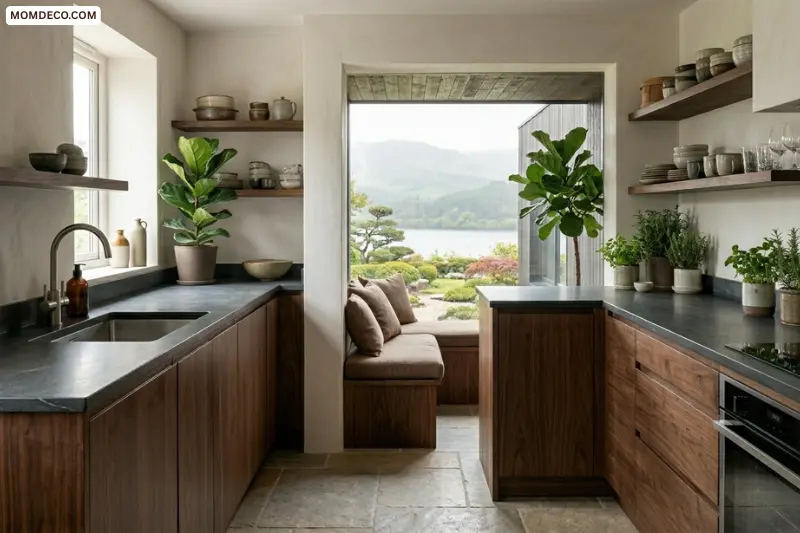
Japanese kitchen cabinets are flat-fronted, handle-free (or with simple minimal pulls), and focused entirely on clean lines. Push-to-open mechanisms keep the facade unbroken. Matte finishes in natural wood tones or soft neutrals work best.
The real magic is inside the cabinets. Japanese kitchen design is obsessed with smart storage:
- Deep drawers with dividers for organized utensils
- Pull-out pantry shelves that maximize every inch
- Built-in rice cooker compartments (a unique feature you rarely see in Western kitchens)
- Magnetic knife strips instead of block storage
- Under-sink organization systems
Everything has a home. The countertop stays clear.
4. Open Shelving — Used Sparingly
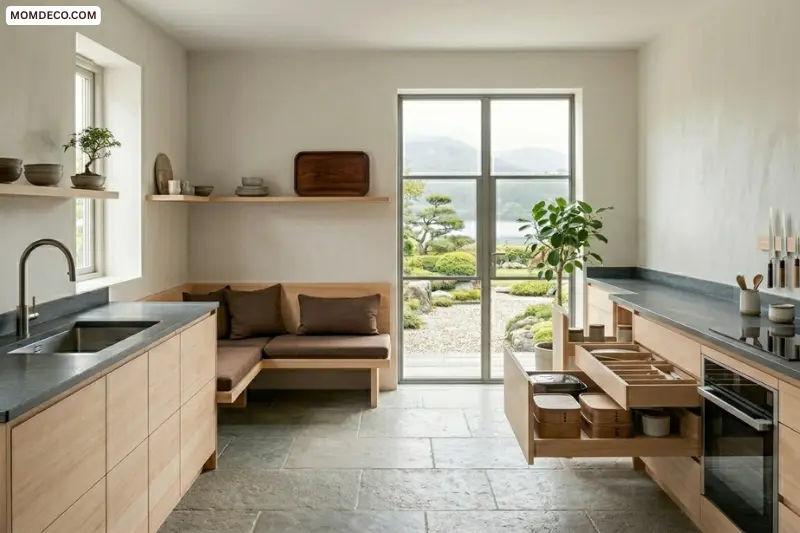
Open shelving is a beautiful feature in a Japanese kitchen, but only when used with discipline. A single shelf displaying a few handmade bowls, a small plant, and a wooden tray looks stunning. A shelf overloaded with mismatched items looks chaotic.
Follow this rule: if it is not beautiful or not used daily, it goes behind a door.
5. Natural Light and Simple Lighting
Japanese kitchen design prioritizes natural light above almost everything else. Large windows, glass doors, and unobstructed skylights flood the space with the soft, changing light of the outdoors.
For artificial lighting, keep it simple:
- Warm LED strips under cabinets for task lighting
- A single pendant light over the island or dining area — choose one in ceramic, bamboo, or washi paper
- Recessed ceiling lights for clean overhead illumination
Avoid bright chrome fixtures or overly industrial styles. Choose fixtures made from natural materials that feel at home in the space.
6. Thoughtful Decor — Less Is Always More
The decor in a Japanese kitchen does not try to impress. It simply belongs.
A few ideas that work beautifully:
- A small Ikebana arrangement (the Japanese art of flower arrangement) — one branch, three stems, nothing more
- Fresh herbs in simple clay or ceramic pots — basil, shiso, or green onions are both functional and beautiful
- A single piece of Japanese pottery on a shelf or countertop
- A handwoven basket for fruit or bread
- A noren (fabric divider) in a doorway for privacy with texture
Resist the urge to add more. When in doubt, remove something.
Japanese Kitchen Styles: Which One Is Right for You?
Not all Japanese kitchens look the same. Here are the three most popular interpretations:
Traditional Japanese Kitchen (Washitsu-Inspired)
This style draws directly from historical Japanese homes. It features dark wood tones, shoji screen panels, tatami-adjacent textures, and very little ornamentation. It works best in homes with a lot of natural wood architecture.
Modern Japanese Kitchen
A sleeker, more contemporary take. Think flat-panel cabinetry in light wood or matte white, stone countertops, integrated appliances, and a strong sense of order. This is the most popular style for Western homes because it blends easily with modern architecture.
Japandi Kitchen
Japandi merges Japanese minimalism with Scandinavian functionality (the word blends “Japan” and “Scandi”). Both cultures share a love of natural materials, neutral tones, and purposeful design. The result is slightly warmer and more relaxed than a pure Japanese kitchen, with a little more comfort and coziness layered in. If you find pure minimalism a bit cold, Japandi is a wonderful middle ground.
How to Transition to a Japanese Kitchen (Without a Full Renovation)
You do not need to gut your kitchen to bring in Japanese design principles. Start here:
- Clear your countertops completely. Only put back what you use every single day.
- Replace one or two items with natural alternatives — a wooden chopping board, a ceramic spoon rest, a bamboo organizer.
- Add a small plant or fresh herb in a simple clay pot.
- Swap out bright or cool-toned bulbs for warm LED lighting.
- Edit your open shelves. Remove two-thirds of what is on them and rearrange the rest with intention.
- Introduce a single neutral textile — a natural linen dish towel, a woven placemat.
Each small change moves the room closer to the calm, purposeful feeling of a Japanese kitchen.
Japanese Kitchen Color Palette: A Practical Guide
| Color Family | How to Use It |
|---|---|
| Warm white / off-white | Walls, upper cabinets, ceiling |
| Natural wood tones | Lower cabinets, shelving, countertops |
| Stone grey / slate | Countertops, backsplash tiles |
| Earthy beige / sand | Textiles, ceramics, accessories |
| Muted sage green | Accent cabinet color, plants, textiles |
| Deep charcoal | Cabinet handles, tap fixtures, single accent wall |
Stick to three to four tones maximum. Consistency creates calm.
Common Mistakes to Avoid
- Too many decorative items. Even beautiful things become clutter when there are too many of them.
- High-gloss finishes. They reflect too much light and feel out of place in a Japanese-style kitchen.
- Mismatched natural materials. Choose two or three materials and use them consistently throughout the space.
- Ignoring storage. A Japanese kitchen looks calm because everything is organized behind closed doors. Good storage is non-negotiable.
- Buying new when old is better. An aged wooden bowl or a worn ceramic cup carries more character than anything brand-new.
Frequently Asked Questions
1. What makes a kitchen “Japanese style”?
A Japanese kitchen is defined by minimalism, natural materials, a neutral color palette, smart hidden storage, and a deep respect for function. The space feels calm, ordered, and connected to nature. The philosophies of Ma (intentional space), Wabi-Sabi (beauty in imperfection), and Kanso (simplicity) guide every design decision.
2. What colors are used in a Japanese kitchen?
Japanese kitchens use warm neutrals — off-white, beige, soft grey, natural wood tones, and occasional muted greens or charcoal accents. Bold or bright colors are avoided. The goal is a palette that feels calm and grounded.
3. What is the difference between a Japanese kitchen and a Japandi kitchen?
A Japanese kitchen draws purely from Japanese aesthetics and philosophy. A Japandi kitchen blends Japanese minimalism with Scandinavian design sensibility — it tends to be slightly warmer, more relaxed, and a little more comfortable. Both share the same love of natural materials and simplicity.
4. What wood is best for a Japanese kitchen?
Light oak, hinoki cypress (a traditional Japanese wood with a pleasant scent), and American walnut are all popular choices. Choose a matte or oiled finish rather than a lacquered or high-gloss one so the natural grain is visible.
5. Can I achieve a Japanese kitchen look on a budget?
Absolutely. Start by decluttering your countertops and editing your shelves. Then add a few natural-material items — a bamboo cutting board, a ceramic pot for herbs, a simple linen towel. The biggest cost of a Japanese kitchen is not buying things; it is having the discipline to remove them.
6. What is Wabi-Sabi and how does it apply to a kitchen?
Wabi-Sabi is a Japanese philosophy that finds beauty in imperfection, age, and the natural cycle of things. In a kitchen, it means embracing the grain of an old wooden shelf, displaying hand-thrown ceramics with uneven edges, and not panicking when a stone countertop develops a soft patina. These are signs of a well-loved, lived-in space.
7. What is Ma and why does it matter in kitchen design?
Ma (間) is the Japanese concept of intentional negative space. In a kitchen, it means designing deliberately empty moments — a clear countertop, a single decorative object on a shelf, an uncluttered corner. These spaces give the room its quiet, calm feeling. Without Ma, even a beautifully designed kitchen can feel busy and overwhelming.
8. Are Japanese kitchens practical for everyday cooking?
Yes — Japanese kitchens are designed around the cook, not just the camera. Smart storage, clear countertops, organized drawers, and a logical workflow make them extremely practical. Many Japanese kitchen storage solutions (pull-out shelves, deep drawer dividers, built-in appliance compartments) are more functional than traditional Western cabinetry.
9. How do I add Japanese style to a small kitchen?
Small kitchens are actually ideal for Japanese design. Focus on maximizing vertical storage, keep countertops completely clear, use light natural wood to keep the space feeling bright, and resist the temptation to add decorative items. A small Japanese-style kitchen can feel far more spacious than a small Western kitchen packed with accessories.
10. What plants work well in a Japanese kitchen?
Fresh herbs like shiso, green onions, basil, and mint work beautifully — they are both functional and aligned with the Japanese preference for purposeful decor. For ornamental plants, a single bamboo stalk, a small bonsai, or a simple moss arrangement fits the aesthetic perfectly.
Final Thoughts
A Japanese kitchen is not a trend. It is a timeless approach to living well. When you design your kitchen with intention — choosing natural materials, embracing simplicity, and leaving space to breathe — you create more than just a beautiful room. You create a place where cooking feels like a ritual and every morning feels a little more peaceful.
You do not need to spend a fortune or tear down walls to get there. Start with what you have. Clear a countertop. Replace one plastic item with something made from wood or ceramic. Add a small plant. Each small step brings the philosophy to life.
The Japanese have understood for centuries that a calm home creates a calm mind. Your kitchen is the perfect place to start.