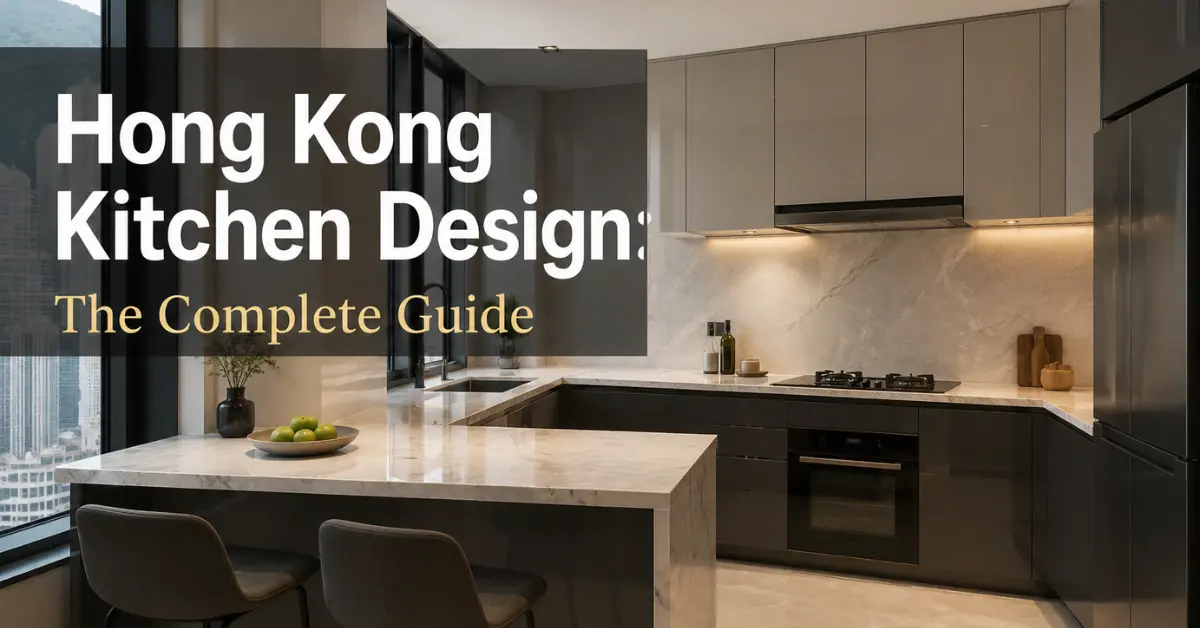
If you live in Hong Kong, you already know the challenge. Your kitchen is small — probably smaller than you’d like. The average Hong Kong Kitchen Design measures between 3 and 8 square metres, and in older public housing estates, it can be even tighter than that.
But here’s the thing: small does not have to mean stressful. The best Hong Kong Kitchen Designs are not larger than the rest — they are smarter. Every centimetre earns its place. Every decision serves a purpose. And the result is a space that works harder, and feels better, than kitchens twice its size.
This guide covers everything you need to design, renovate, or upgrade your Hong Kong Kitchen Design — including topics that most other articles completely skip, like feng shui, real renovation costs in HKD, and building approval rules.
What Makes a Hong Kong Kitchen Different?
A Hong Kong Kitchen Design is shaped by three realities that you will not find in the same combination anywhere else in the world.
The space reality. Hong Kong has one of the highest population densities on earth. Kitchens are the most compressed room in most apartments. A 5-square-metre kitchen is not unusual — it is standard.
The cooking reality. Hong Kong cooking is serious and frequent. Many households cook daily over a gas wok burner at very high heat. Stir-frying, deep-frying, steaming, and braising all produce significant oil fumes and steam. This is why ventilation is not just a nice-to-have detail in a Hong Kong Kitchen Design — it is the most important technical decision you will make.
The cultural reality. The kitchen is a family space. Cooking together — parents and children side by side — is a meaningful daily ritual for many Hong Kong families. A kitchen that isolates the cook misses something important.
Choosing the Right Layout
Layout matters more than style in a small space. The wrong layout creates daily friction that accumulates into real frustration over months and years.
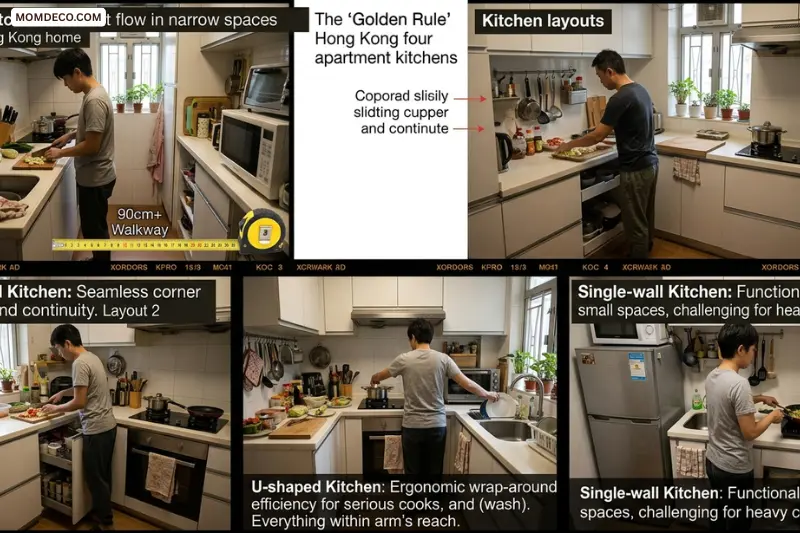
The golden rule is the prep → cook → wash flow. Your chopping area, cooktop, and sink should sit in a natural sequence that minimises unnecessary movement. If you have to cross the room between these three zones, the kitchen will always feel harder to use than it looks on paper.
Galley (corridor) kitchen — The most common layout in Hong Kong apartments. Two parallel runs of counters facing each other. Efficient, practical, and well-suited to narrow spaces. The walkway between the two sides should be at least 90cm wide. Keep the prep-cook-wash sequence along one side to avoid zig-zagging.
L-shaped kitchen — Works well in slightly larger kitchens or where one wall opens toward the living area. Provides good counter continuity and a natural zone for storage in the corner.
U-shaped kitchen — The most ergonomically efficient layout for households that cook seriously and regularly. Everything wraps around you and sits within arm’s reach. Requires more floor area (at least 2 metres of clearance in the centre), but when the space allows, it transforms the daily cooking experience completely.
Single-wall kitchen — All appliances and counters along one wall. Common in studio apartments. Functional for light cooking, but challenging for daily high-heat cooking due to limited counter and prep space.
Open vs. Semi-Open vs. Closed Kitchen
This is the decision that divides Hong Kong homeowners more than any other. There is no universally right answer — only the right answer for your cooking habits and lifestyle.
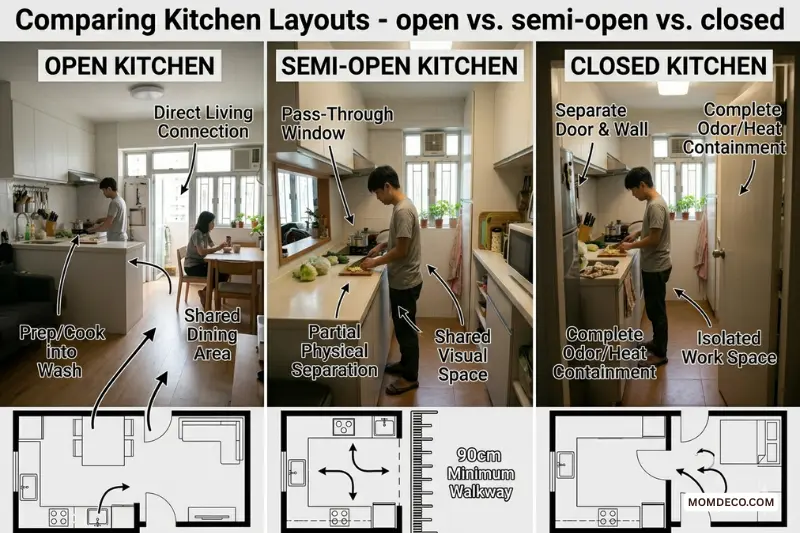
Open Kitchen
Removes the wall between the kitchen and the living or dining area entirely. The apartment feels larger, lighter, and more social. The cook stays connected to the family while cooking.
The downside is equally significant if your cooking style does not match. Oil fumes from a hot wok travel directly into the living room and settle onto sofas, curtains, and walls. For light cooking households, an open kitchen can be wonderful. For daily stir-fry households, it often becomes a maintenance problem.
Closed Kitchen
A full wall and door separates the kitchen entirely. Best odour and grease control. The main challenge is that the space can feel dark and enclosed without careful design. Modern closed kitchens solve this by incorporating glass panels in the wall or door to borrow light from adjacent rooms.
Semi-Open Kitchen — The Hong Kong Sweet Spot
For most Hong Kong households, the semi-open kitchen is the most practical and flexible solution. Common approaches include:
- Sliding glass door — Open during light cooking for connection and airflow. Slide closed during heavy stir-frying. Maximum flexibility.
- Glass partition wall — A fixed glass screen separates the kitchen visually but allows light to pass through. The eye still travels; the fumes do not.
- Half-wall with counter — Creates a breakfast bar on the living side and extra counter space on the kitchen side.
- Bifold glass panels — Stack neatly when open. Popular in newer renovations for a clean, architectural look.
A simple rule of thumb: if you cook lightly most days, open or semi-open works well. If you stir-fry regularly, semi-open with a sliding door is the safest bet. If you deep-fry often, go closed or use a very well-sealed semi-open layout paired with a powerful range hood.
Ventilation and Oil-Fume Control
If there is one section of this guide that could save you years of regret, it is this one. Ventilation is the most underestimated element in Hong Kong kitchen design — and the most expensive mistake to fix once the renovation is finished.
Why It Matters More Here Than Anywhere Else
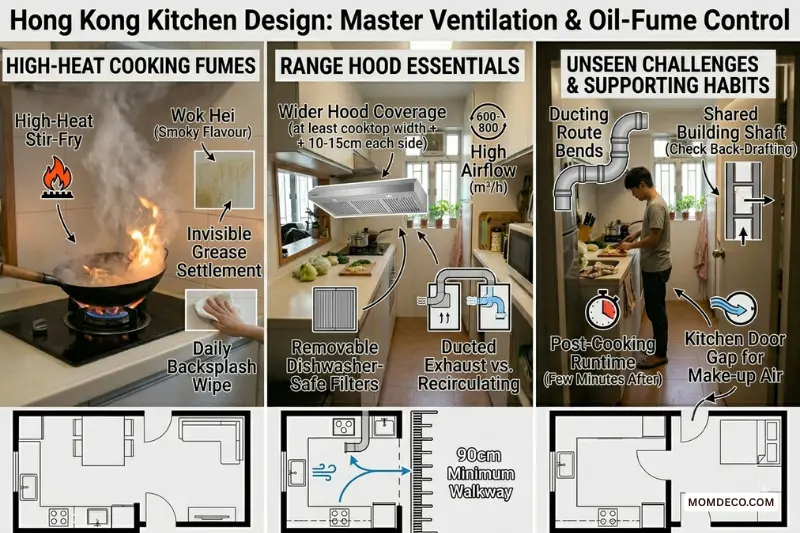
Cantonese cooking — the foundation of most Hong Kong home cooking — involves high temperatures. Wok hei, the smoky charred flavour that defines great stir-fry, requires a screaming-hot burner that produces significant fumes. These fumes are not just unpleasant — over time, airborne grease settles invisibly on every surface in the home.
What to Look for in a Range Hood
- Coverage — The hood should be at least as wide as your cooktop, ideally 10 to 15cm wider on each side. A hood that is too narrow lets fumes escape around the edges.
- Airflow capacity — Measured in cubic metres per hour (m³/h). For a gas wok burner, look for a minimum of 600–800 m³/h. Higher is better if your duct route is long or has bends.
- Duct route — Plan the duct path before finalising your cabinet layout. Every 90-degree bend reduces hood performance significantly. This is a step most people skip until it is too late to change easily.
- Ease of cleaning — A hood you can actually maintain is far more valuable than a beautiful one you avoid touching. Look for removable filters that are dishwasher-safe.
- Ducted vs. recirculating — Ducted hoods, which exhaust fumes outside, are always more effective. In older buildings without external duct access, a recirculating hood with charcoal filters may be the only option.
One Detail Most Guides Miss
Some Hong Kong apartment buildings use shared ventilation ducts. If your duct connects to a shared shaft, check with building management before installing a high-powered hood. Back-drafting from neighbouring units can be a real and frustrating problem. Your contractor should verify this during the planning stage.
Supporting Habits That Make a Real Difference
Run the range hood for a few minutes after you finish cooking, not just during. Wipe the backsplash and cooktop area daily — grease builds up invisibly and becomes much harder to remove over time. If your kitchen has a door, leave a small gap at the bottom to help the hood draw replacement air efficiently.
Smart Storage Solutions
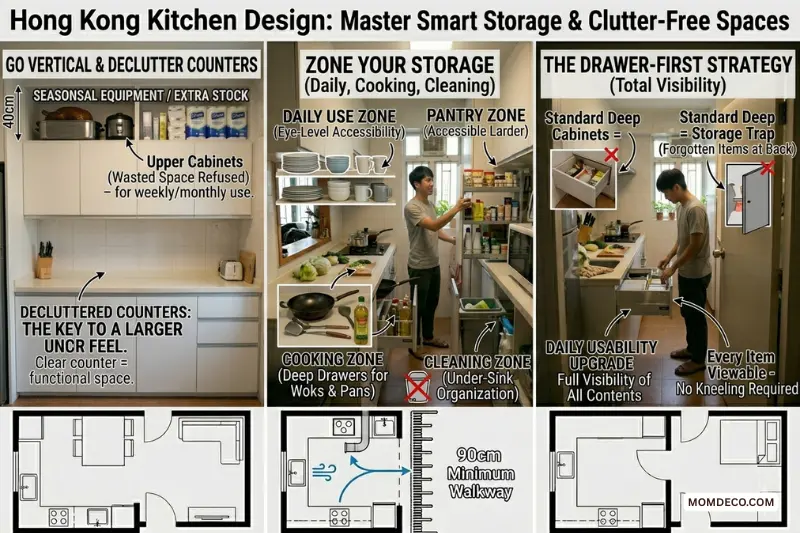
In any Hong Kong Kitchen Design, storage is the challenge that never fully resolves itself. The goal is not to find more places to put things — it is to build storage that makes your daily routine easier and keeps your countertops clear.
Cluttered counters are the single biggest reason small kitchens feel smaller than they are. A kitchen with 4 square metres of genuinely clear counter space functions better than a 7-square-metre kitchen where every surface is occupied.
Go Vertical
Floor-to-ceiling cabinetry is the most effective storage upgrade available. Most apartments stop cabinets at head height, wasting 40 to 60cm of vertical space above. Use this upper zone for items you need weekly rather than daily — seasonal equipment, extra stock, rarely used appliances.
Zone Your Storage
Assign a clear purpose to each area of the kitchen, then build storage to support that zone:
- Daily use zone — Plates, bowls, cups, and everyday utensils. At or just below eye level. Should open and close in seconds.
- Cooking zone — Woks, pans, spatulas, and cooking oils. Adjacent to the cooktop. Deep drawers work far better than base cabinets for pots and pans.
- Pantry zone — Dry goods, sauces, and canned goods. A pull-out larder unit with individual shelves is far more accessible than a deep, dark cabinet.
- Cleaning zone — Under-sink storage for cleaning products and a pull-out bin. A pull-out bin is much more usable than a freestanding one in a tight space.
The Drawer-First Strategy
Deep base cabinets are storage traps. You can see what is at the front and forget what is at the back. Replace base cabinets with deep drawers wherever possible. Drawers give you full visibility of everything inside without kneeling on the floor to search. This single change dramatically improves daily kitchen usability.
Feng Shui in the Hong Kong Kitchen Design
This is a topic that most competing articles skip entirely — yet for a significant portion of Hong Kong homeowners, feng shui is a genuine and important factor in kitchen planning.
In Chinese culture, the kitchen represents nourishment, family health, and prosperity. A feng shui master is often consulted before renovation begins — not just to assess the apartment’s overall orientation, but to evaluate specific kitchen elements.
Key feng shui principles for the kitchen:
- Stove and sink placement — Fire (stove) and water (sink) are opposing elements in feng shui. Placing them directly adjacent, especially facing each other, is considered disruptive to household harmony. Positioning them at a 90-degree angle, or with a small visual barrier between them, resolves this tension.
- The cook’s position — Standing with your back to the kitchen entrance is considered unsettling because you cannot see who enters the room behind you. Whenever possible, design the layout so the cook faces the doorway, or add a small mirror that provides a reflected view of the room.
- Clutter-free surfaces — Feng shui strongly emphasises clear worktops and organised storage, which aligns perfectly with good small-kitchen design logic. A cluttered kitchen is considered to block the flow of positive energy through the home.
- Light and airflow — A kitchen that receives natural light and good air circulation is considered auspicious — another strong argument for semi-open layouts or glass elements that let daylight travel into the kitchen.
If feng shui matters to your household, consult a practitioner before finalising your layout. Changes to cooktop placement after cabinets are installed are costly and disruptive.
Materials and Finishes That Last
Material choices in a Hong Kong Kitchen Design must survive heat, humidity, grease, and daily cleaning — often all at once. Beautiful finishes that require constant maintenance will age both you and the kitchen quickly.
Countertops — Quartz is the most popular choice for good reason: non-porous, heat-resistant, easy to clean, and available in a wide range of colours. Stainless steel is highly hygienic and practical. Marble is beautiful but porous — it stains easily from oils and food acids and is rarely practical in an active Hong Kong Kitchen Design.
Backsplash — The backsplash takes more abuse than any other kitchen surface. Large-format tiles with minimal grout lines are far easier to maintain than small mosaic tiles with dozens of grout seams. Tempered glass panels are fully seamless and wipe clean in seconds. Avoid textured surfaces in the cooking zone — they trap grease.
Cabinet finishes — High-gloss lacquer reflects light and makes small kitchens feel brighter. Matte finishes are fingerprint-resistant but can be harder to wipe clean over time. A satin or semi-matte finish offers a practical middle ground. Melamine laminate is durable and cost-effective.
Flooring — Porcelain tiles are the most practical choice: durable, water-resistant, and easy to clean. Use a slip-resistant finish near the kitchen entrance. Avoid wood flooring in active Hong Kong Kitchen Design — the humidity and oil exposure causes warping and staining over time.
Popular Design Styles in Hong Kong Kitchen Designs
Once the functional decisions are made, style becomes the finishing layer. These are the design directions most popular in Hong Kong Kitchen Designs right now.
Modern minimalist — Clean lines, handleless cabinets, integrated appliances, and a limited colour palette of whites, light greys, or warm creams. Maximises the sense of space and is very easy to keep looking tidy. The most popular style in new developments and renovated apartments.
Japandi (Japanese-Scandinavian) — A blend of Japanese wabi-sabi and Scandinavian functionalism. Natural wood tones, warm whites, muted greens and taupes, and an emphasis on purposeful, crafted objects. Very popular among Hong Kong’s design-conscious community.
Industrial — Exposed concrete or concrete-effect tiles, stainless steel appliances, matte black hardware, and open shelving. Works particularly well in older Hong Kong apartments where raw finishes complement the building’s existing character.
Light luxury (輕奢) — A style uniquely popular in Hong Kong and mainland China. Combines premium-feeling materials — brushed brass hardware, stone-effect surfaces, fluted glass cabinet doors — with a restrained and elegant layout. Sophisticated without being ostentatious.
Contemporary with heritage touches — A growing trend: modern, functional layouts with subtle nods to traditional Hong Kong aesthetics. Classic green-and-white geometric tiles as a backsplash accent, warm bamboo open shelving, or traditional window grille patterns incorporated as a decorative screen element.
Hong Kong Kitchen Design Renovation Costs (2025)
This is information that most competing articles do not provide — but it is what most people searching for Hong Kong Kitchen Design advice genuinely want to know.
Basic refresh (new cabinet doors, countertops, painting) — HK$30,000 to HK$60,000
Mid-range renovation (new layout, quality materials, updated appliances) — HK$60,000 to HK$150,000
Premium renovation (custom cabinetry, high-end appliances, full interior design service) — HK$150,000 to HK$300,000 and above
Range hood (quality residential) — HK$3,000 to HK$15,000
Semi-open glass partition or sliding door system — HK$8,000 to HK$25,000
Interior designer fee (if engaged separately) — HK$15,000 to HK$50,000 and above
Always get at least three detailed, itemised quotes before committing. Prices in Hong Kong vary significantly between contractors, and a detailed scope of work makes quotes genuinely comparable.
Renovation Approvals — What You Must Know
Most Hong Kong homeowners are not aware of the approval requirements before renovation begins. Depending on the scope of your project, you may need consent from:
- Building management — Most residential buildings require prior written approval before any renovation work starts. This covers permitted working hours, contractor registration, waste disposal arrangements, and sometimes specific rules about which structural changes are allowed.
- Buildings Department — If you plan to remove or alter a structural wall, relocate plumbing, or significantly change ventilation ducts, a Minor Works registration or formal submission may be required under the Buildings Ordinance.
- Housing Authority (public housing only) — Residents of public housing estates face additional restrictions. Many structural alterations are not permitted at all.
Proceeding without required approvals can result in mandatory reinstatement at your own cost. Always confirm requirements with your building management office before work begins.
5 Common Mistakes to Avoid
1. Underestimating ventilation. Choosing a range hood based on appearance rather than performance and duct compatibility. This is the most common and most expensive mistake. A beautiful hood that cannot handle your cooking style is worthless — and replacing it after cabinets are built is extremely disruptive.
2. Choosing an open kitchen that does not match your cooking style. The visual appeal of an open kitchen is real, but so is the daily reality of high-heat cooking filling your living space with grease and fumes. Match the layout to how you actually cook, not how you would like to imagine you cook.
3. No dedicated prep zone. Without a clear, consistently available countertop area for chopping and preparation, the kitchen always feels disorganised. Counters fill up, and cooking becomes a constant battle against clutter.
4. Oversized appliances. A large fridge or double oven can look impressive but destroy the workflow in a small kitchen. In Hong Kong apartments, compact and well-placed appliances almost always outperform their larger equivalents. Measure carefully before buying.
5. Ignoring renovation approvals. Starting work without building management consent or required Buildings Department notification. Even seemingly minor work — relocating a gas point, breaking into a tiled wall — may require formal approval. The risk of enforcement action and forced reinstatement is real.
Your Pre-Renovation Checklist
Before spending a single dollar, work through this list. It takes an afternoon and can save you months of regret.
- Know your cooking style — How often do you cook, and at what heat? Your honest answers drive every major decision that follows.
- Decide on the openness level — Open, semi-open, or closed — based on your cooking habits and how connected you want the kitchen to feel with the rest of the home.
- Plan ventilation first — Choose your hood and map the duct route before finalising any cabinet layout. Confirm whether your building uses shared or dedicated ventilation ducts.
- Confirm approval requirements — Contact your building management office before any work begins. Ask specifically about structural changes and plumbing relocation.
- Map your storage zones — List everything you need to store. Assign each category to a zone, then design cabinets to serve those zones.
- Choose materials for real life — Ask yourself: can I clean this in 30 seconds after cooking? If the answer is no, reconsider.
- Consult a feng shui practitioner if relevant — Do this before finalising the cooktop position, not after.
- Get at least three contractor quotes — Based on a detailed, itemised scope of work so that prices are genuinely comparable.
Frequently Asked Questions
How small is the average Hong Kong Kitchen Design?
Most Hong Kong apartment kitchens range from 3 to 8 square metres. In older public housing estates, kitchens can be as small as 3 to 4 sqm. In newer private developments, 6 to 8 sqm is more common. A well-designed kitchen functions beautifully even at the smaller end of that range.
Is an open kitchen practical for regular Hong Kong cooking?
It depends on how you cook. For households that primarily steam, heat leftovers, or cook lightly, an open kitchen can be wonderful. For households that stir-fry or deep-fry regularly, the oil fumes travelling into the living space become a daily problem. A semi-open kitchen with sliding glass doors is the most flexible compromise for most Hong Kong families.
Do I need approval to renovate my Hong Kong Kitchen Design?
Almost certainly yes, at minimum from your building management. If you are removing walls, relocating plumbing, or altering ventilation ducts, you may also need to notify the Buildings Department. Always confirm before starting work.
What is the most important element in a Hong Kong kitchen?
ventilation. Given the high-heat cooking style common in Hong Kong households, a properly sized and installed range hood with a well-planned duct route is the single most impactful decision you will make. Get this wrong and no amount of beautiful design will compensate.
Should I consider feng shui when designing my Hong Kong Kitchen Design?
If it matters to your household, absolutely — and consult a practitioner before finalising your layout, not after. Even from a purely practical standpoint, most feng shui kitchen principles overlap with good design: clear surfaces, good natural light, strong airflow, and a layout where the cook can comfortably see the room around them.
What layout works best for a very small Hong Kong kitchen?
A galley layout is usually the most efficient. Keep the prep-cook-wash sequence logical along one side, ensure the walkway is at least 90cm wide, go floor-to-ceiling with cabinetry, and use deep drawers instead of base cabinets wherever possible.
Final Thoughts
A Hong Kong Kitchen Designs is a masterclass in purposeful design. When space is limited, every decision counts — and the best decisions always start with how you actually live, not how you would like the kitchen to look in photographs.
Start with ventilation. Design around your cooking style. Go vertical with storage. Choose materials that survive real daily use. And if feng shui matters to your household, bring it into the conversation early.
Get those fundamentals right, and the style — the colours, the cabinet handles, the tile pattern — becomes the easy and enjoyable part. That is the Hong Kong Kitchen Design philosophy in its simplest form: function first, beauty as the result.